While it was unpopular when it emerged in Germany three decades after the nation was decimated by the fallout of World War II, there are few music subgenres today that are not in some way indebted to the experimental, hypnotic and convention-defying collection of sounds that is krautrock.
Indeed, krautrock, a progressive yet minimal music style defined by German bands like CAN, Neu!, Faust, Amon Duul and early Kraftwerk in the 1970s, has left its mark on post-punk, post-rock, alternative rock, synthpop, synth-punk, electronic music and countless other obscure genre combinations.
One of the defining and essential characteristics of krautrock is the motorik beat, a 4/4 rhythm characterized by a constant kick-drum pulse that moves the music forward on an endless hypnotic path.
What inspired the relatively simple motorik beat that went on to revolutionize popular music? CAN drummer and Jaki Liebezeit, one of the beat’s originators, provided some insight in the BBC documentary “Krautrock — The Rebirth of Germany.”
“A guy came to me and said, ‘You must play monotonous.’ He said it with a voice and with a(n) expression so I was quite impressed. I don’t know, he was a kind of freak. Maybe he had taken a(n) LSD trip or something. He was completely strange. I started thinking about it, to ‘play monotonous.’ What did he mean ‘monotonous?’ So I started to repeat things.”
An equally important innovator of the motorik beat, Neu!’s Klaus Dinger, told The Wire that the duo’s sound was the result of a “very conscious” effort to avoid sounding like British and American bands. Dinger agreed with the interviewer’s assertion that the essence of Neu! was “stripping everything down to the bone, cutting away everything and starting again from the bare beat.”
Dinger explained about the monotony of the motorik beat:
“If you take a close look at this, it is not as easy as it looks. It is, eh, (yeah), I myself thought, I mean, it is in a way very easy if you look at big master drummers, compared with that it is but energy-wise it can be much stronger than this. Let’s call it artificial dru(mming) also, artistic drumming, it is a totally different story, but I think the important thing is how to do this seemingly simple thing, how alive or how fresh or how forward instead of backward instead of like this, which is more African or more machine styles, I was always dreaming or aiming at this, so, fast, also forward, forward, forward, forwards and so on, and people with this mentality it is maynot not so difficult.”
The purest examples of motorik can be heard on CAN’s “Mother Sky” and Neu!’s “Hallogallo,” while a more electronic and ambient reimagining of the beat can be heard on Kraftwerk’s “Autobahn.”
“A Spiritual Epiphany”: Krautrock Reaches Britain
Krautrock’s first major influence in popular music can be heard in the post-punk and art rock of the late 70s and early eighties. In particular, David Bowie’s “Berlin Trilogy” collaborations with Iggy Pop and Brian Eno are bursting with krautrock influence, including the motorik-influenced tracks “A New Career in a New Town” on Low and “Red Sails” on Lodger.
“I was a big fan of Kraftwerk, Cluster and Harmonia, and I thought the first Neu! Album, in particular, was just gigantically wonderful,” Bowie said in a 1997 interview with Mojo. “Looking at that against punk, I had no doubts where the future of music was going, and for me it was coming out of Germany at the time.”
Here’s what the always esoteric Iggy Pop had to say about the influence the music of Neu! and drumming of Klaus Dinger: “Boy, to put Neu! into words. The drummer was playing in a way that when you listen to it, allowed your thoughts to flow; allowed emotions to come from within, and occupy the active parts of your mind, I thought. It allowed beauty. To get there, the guy had somehow find a way to free himself from the tyranny of stupid blues rock, of all conventions that I’d ever heard. Some sort of a pastoral psychedelicism.”
Iggy was also fan of Kraftwerk, whose influence can be heard all over 1977’s The Idiot on tracks like “Nightclubbing” and “Mass Production.” “The big one for me was Radioactivity. I would go to sleep at night listening to (what sounded like) a Geiger counter. All it is is eh-eh, eh-eh, eh-eh-eh-eh, eh-eh-eh-eh-eh-eh-eh-eh-eh as they manipulate the wand closer and farther from a piece of radioactive material.”

The Iggy Bowie and Eno collaborations would serve as the creative starting point for several influential post-punk bands, including Joy Division and Public Image Ltd.
Stephen Morris of Joy Division and New Order, who discovered krautrock through glam rock bands like David Bowie and Roxy Music, said he and a classmate, Mac, were so inspired by CAN that they were going to start a band.
“I discovered krautrock about that time, and Can — I was into ‘Tago Mago,’” he said in 2019. “It never got off the ground, but through Mac’s elder brother I got into Can and then, after Can, Amon Duul and Neu!”
Bauhaus and Love and Rockets bassist David J said this in 2016 about the influence krautrock had on him:
“The first time I became exposed to Krautrock I head a track on ‘The Old Grey Whistle Test’ TV show. So, they played this track, ‘Dizzy Dizzy’ from Can’s ‘Soon Over Babaluma’ record — and it just blew my mind [laughs], I just loved it so much. It was a single, and I went out and got the 7-inch single, which I still have. It was 1974 and I used to play it incessantly in the art school club room. And then I got into that album, and the album before — ‘Future Days’ — and I really was fascinated by that band. I think they were quite ahead of their time and really interesting, with their juxtaposition of different styles and using tape loops and all of that.”
David J also spoke fondly of Faust and Kraftwerk and in particular their motorik-driven magnum opus: “Kraftwerk came on the scene, and the first thing I heard from them was ‘Autobahn.’ I have quite a vivid memory of the first Bauhaus tour of Germany, driving down the Autobahn and listening to ‘Autobahn’ and it being something of a spiritual epiphany. It was joyous — the Bauhaus bandwagon, just driving down the Autobahn.”
Public Image Ltd. founder John Lydon, aka Johnny Rotten, actually learned about krautrock through his Sex Pistols compadre Sid Vicious: “And if you want to know how I first found out about Can, it was from Sid! And I don’t mind telling anyone that ‘cos that’s the truth, that’s how we were with music. We’d all go out and find our things, and you might not like it, or you might, but that’s what it was all about.”
Rhythmically and stylistically, PIL was much more influenced by krautrock experimentations than the raw and power-chord-driven Sex Pistols.
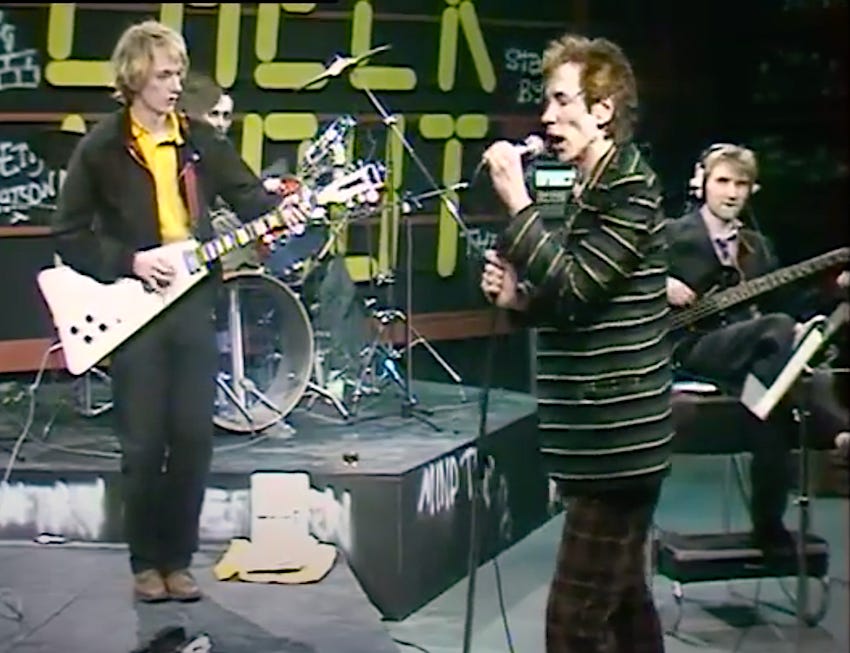
“(N)ow it’s fashionable to say that we copied CAN … CAN were a band nobody tolerated then, or Magma, or Neu!, but you know, I wasn’t going with that because I was fashionably weird, it’s just what I liked,” Lydon, who was once asked by CAN to join the group, said in 2004.
“CAN were a band nobody tolerated then” – John Lydon
Mark E. Smith of The Fall, another seminal British post-punk act, was so influenced by CAN that he wrote a song called “I Am Damo Suzuki” after the band’s lead singer.
“The first record I bought was ‘Tago Mago,’” Smith said in an interview. “When I was 15, I was a hardcore Velvet Underground fan. And other friends of mine who were also listening to The Velvet Underground told me that I should listen to CAN. So I filled out a postcard, and two weeks later I got back a CAN record — from London.”
Smith went on to say that CAN’s music “formed my skills listening to it” at a time when “everybody was listening to Pink fucking Floyd and The Beatles.”
“They were shit. But CAN were great … Manchester people always liked CAN. That’s why we are called ‘The CAN People’ since 1973. To earn some money I was working on the docks.”
Smith was one musician who didn’t learn krautrock from Bowie. “All music during that period was fucking shite — David Bowie, Genesis, Pink Floyd and James Taylor. Crap. CAN saved my life.”
Metronomic Underground: Alt Rock, Noise Pop and Post-Punk Revival
Krautrock and the motorik beat in particular went on to have a significant influence on the alternative rock of the 1990s and the post-punk revival of the 2000s, including on bands like Sonic Youth, Stereolab, Queens of the Stone Age, Radiohead, Interpol and LCD Soundsystem.
On Sonic Youth’s work from 1985 onward, the period drummer Steve Shelley joined the band, the motorik beat and its variations can be heard everywhere: “Dirty Boots,” “Tunic,” “Mildred Pierce,” “Teen Age Riot’;” believe me when I say these are just a few of the songs indebted to drummers like Dinger and Liebezeit.
Shelley was hardly the only Youth who idolized krautrock. In 2016, Thurston Moore played a collaborative concert with CAN keyboardist Irmin Schmidt.
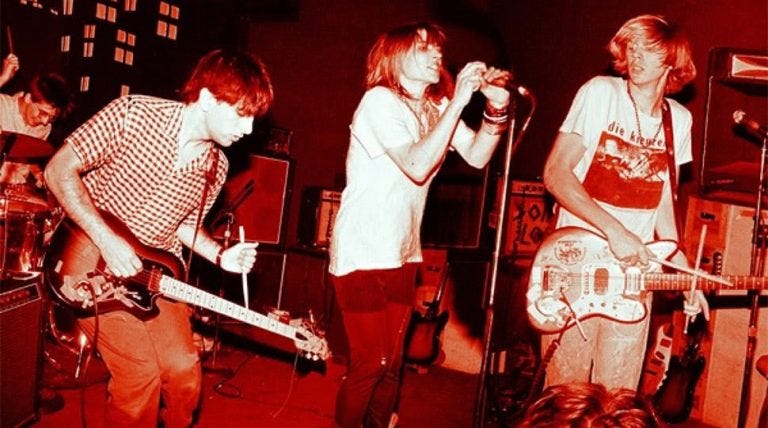
Sonic Youth guitarist Lee Ranaldo told the Phoenix New Times in 2001 that Neu! were “aural visionary minimalist icons in a wilderness of psychedelia and beyond inspired us with their heroic beats and flat-out grooves on the expressway to our collective skulls.”
Radiohead mastermind Thom Yorke told the same outlet that Neu! sounded “like joy. Like endless lines stretching on forever in parallel. Like being so out of breath you can’t feel your hands. Like when the future looked bright and clean and we’d know what to do if there was a problem. Like all those electric cars I remember in children’s books about the 21st century.”
Even more indebted to krautrock than Sonic Youth are fellow 90s noise rockers Stereolab, whose 18-minute “Jenny Ondioline” is just as epic a motorik ride as “Autobahn” or “Hallogallo.”
“Motorik was the total inverse of technique,” Stereolab guitarist and co-founder Tim Gane told the Guardian in 2019. You don’t have to be a good drummer — you just don’t change. But for good or bad I’m very attracted to melody, even in the most avant-garde machine noise.”
In addition to the motorik beat, the electronic experimentations of Kraftwerk, Neu! and Cluster can be heard on the synth-driven noise offerings at the center of the Stereolab sound (Listen to “Crest” or “Wow and Flutter” for an example).
Similarly, New York dance-punk outfit LCD Soundsystem drew heavily from the synthier side of krautrock (The opening track of Sound of Silver, “Get Innocuous!,” samples Kraftwerk’s “The Robots”).
LCD Soundsystem’s James Murphy said this about the rhythmic interplay on CAN’s “Mother Sky”: “I remember playing this track at my first DJ set at the DFA office. We had a big room that we threw parties in, with 600 or 700 people in there. I was drunk and high and playing records I liked, and it was infectious — everyone was happy. That was a real lesson I never forgot.”
For further listening of krautrock’s influence on this era of music, listen to Queens of the Stone Age’s “Regular John” or Interpol’s “Roland.”
“Sitting in that Groove for Ages”: Krautrock’s Lasting Impact
Fifty years since the release of “Hallogallo,” krautrock’s influence on popular music is as prominent as ever. From the post-rock epics of Swans in the 2010s to the more recent industrial minimalism of Gilla Band (formerly Girl Band) and the synth-punk revival of Viagra Boys, krautrock is everywhere and eternal.
“Before I joined the band, the lads had all started getting into krautrock,” said Gilla Band drummer Adam Faulkner. “There’s a very easy transition from listening to the likes of CAN for eras and eras and eras because it’s so repetitive, and then going and listening to minimal techno. You’re literally just changing the instruments, the ethos is the same. Just sitting in that groove for ages.”
Another contemporary act that likes to “sit in that groove for ages” is Jesu, the industrial shoegaze side project of Godflesh’s Justin Broadrick, who cited krautrock as an influence.
“I might have a mad listening session of stuff from the seventies, some form of krautrock I loved when I was a kid and I’ll hear something that I could maybe re-interpret as a beat,” Broadrick said in 2012. “I often switch modes — I’ll listen to, say, an old CAN record and I’ll hear a syncopated rhythm and think “that could be a beat that I’ll use!”
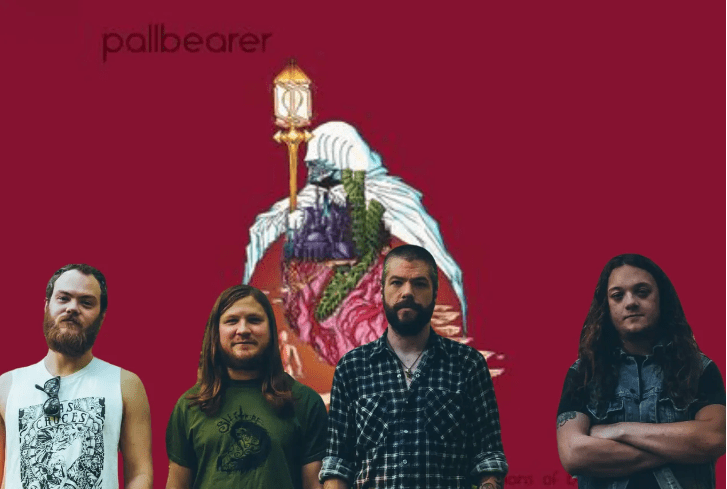
And yes, krautrock influenced my band as well. Check out Mass Production on Spotify or YouTube and let me know if you can hear any CAN or Neu! in there.
There are plenty more corners of contemporary music that owe a deal of gratitude to krautrock, electronic music, for example, but I’ll let those connections be drawn by someone more familiar with these types of music.


 apostatemusic.com
Leave a comment